




Fish Feed Facility
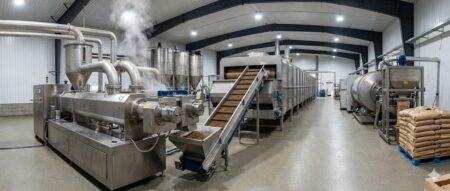
Fish Feed Production Facilities: Floating and Sinking Feed Technologies
The most important factor determining profitability in aquaculture is the production of feeds with a high “Feed Conversion Ratio” (FCR) that are suitable for the fish species and their feeding habits. Our company produces feeds that meet the biological needs of different fish species, preserve nutritional value, and minimize water pollution. Turnkey Fish Feed Production Facilities Our facilities are able to offer both floating and sinking bait production under one roof by making parameter changes in the production line.
Floating Fish Feed Production Processes
Floating baits, critical for surface-feeding fish species (trout, salmon, tilapia, etc.), are based on the principle of high expansion and low density. The main performance expected from this line is the bait’s ability to remain suspended on the water surface for a long time and maintain its shape without disintegrating.
Extrusion Technology: The heart of floating feed production is the twin-screw extruder. The raw material is processed under high pressure and temperature. The sudden pressure drop at the moment of exiting the mold causes the product to expand and create air pores. This porous structure guarantees that the feed floats in water without sinking.
Starch Gelatinization: High-heat treatment ensures complete gelatinization of the starch, making it easier for fish to digest and increasing the feed’s water resistance.
Ease of Observation: The fact that the produced feed remains on the water surface allows for monitoring the fish’s feed consumption, thus preventing unnecessary feeding and protecting water quality.
Sinking Fish Feed Production Technologies
Sinking baits designed for bottom-dwelling fish (sea bream, sea bass, shrimp, etc.) require a high-density and compact structure. The aim is for the bait to sink quickly to the bottom but maintain its integrity without disintegrating in the water.
Density Control: In sinking feed production, the pressure and temperature parameters in the extruder are adjusted to prevent expansion, or special vacuum systems are used. This prevents the formation of air voids in the internal structure and results in a dense pellet.
Vacuum Oil Coating: The addition of oil to increase the energy content of the feed is carried out in special vacuum coating units for sinking feeds. The process under vacuum allows the oil to penetrate deeply into the pores of the feed; this increases the weight of the feed, optimizes the sinking speed, and prevents oiling on the water surface.
Water Stability: Bottom feeds have a long dissolution time in water. The conditioning and compaction processes in our facilities ensure that the feed remains intact at the bottom for a long time, preventing the water from becoming cloudy.
With our modern fish feed facilities, we offer high-standard, nutritious, and economical production solutions for both surface and bottom-dwelling fishery.